

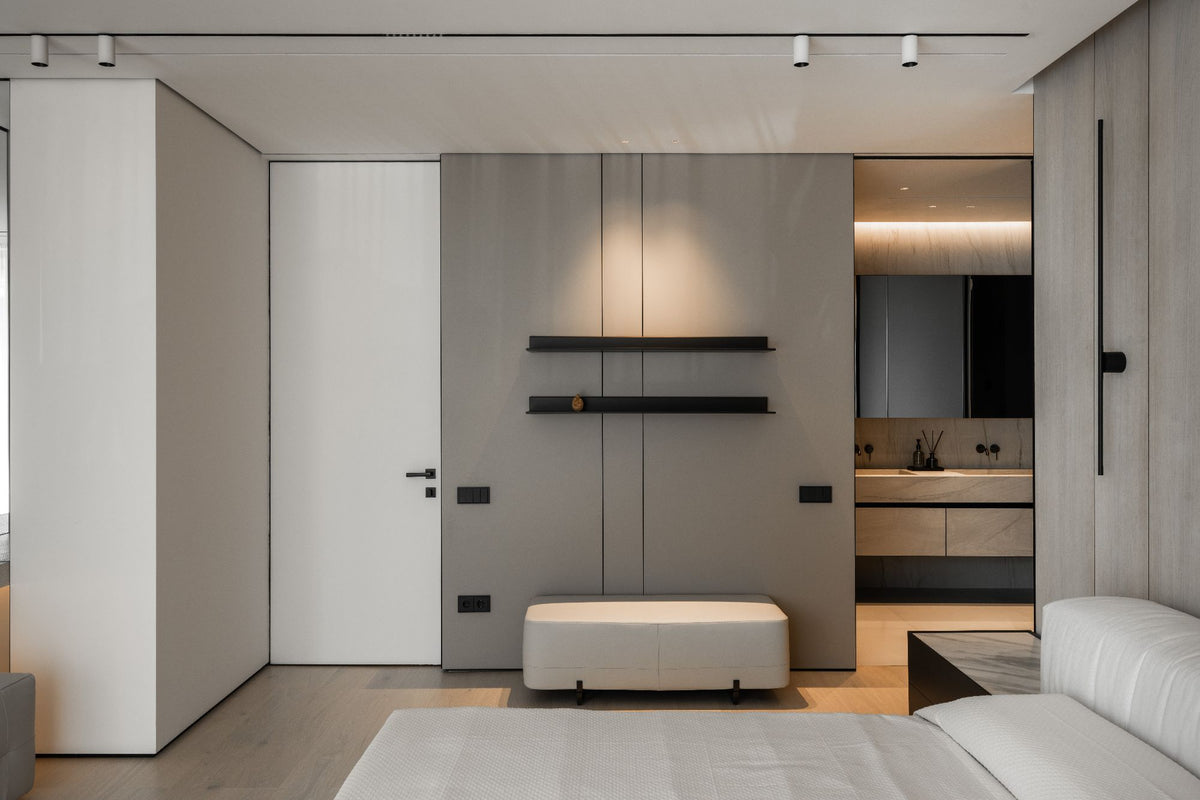
Shadow Gap concealed skirting boards have become increasingly popular in recent years. Emerging as an alternative to standard skirting boards, they have quickly taken the interior design world by storm with their minimalist, clean look.

Architects and interior designers have quickly "adopted" them in their minimalist projects, because they solve in the most elegant way the problem of the junction between different surfaces: floor-wall, ceiling-wall, step-wall.

The concept behind concealed profiles is simple: they create a space between the base of the wall and the floor. The shadow niche created outlines the base of the wall, becoming a minimalist and discreet finish. Some profiles can also be mounted at the junction between the wall and the ceiling, creating a floating wall effect.

Over time, we have received many questions and concerns about the Shadow Gap hidden skirting board. In this article, we answer the most common ones: how to install the Shadow Gap hidden skirting board, what are the advantages of the Shadow Gap hidden skirting board, how to maintain the Shadow Gap hidden skirting board, etc.

1. How to install? Are there several types of installation?

The Shadow Gap concealed skirting board is easy to install and fits perfectly with plasterboard or tiled walls. This type of skirting board is installed by following these steps:

Installation for plaster wall:
1. Pour the screed.
2. Plaster the wall and leave approximately 80mm of space to the screed.
3. Prepare the wall surface for the finish coating.
4. Install the finished wooden floor, leaving approximately 5mm to the raw wall.
5. Install the skirting board with adhesive or, optionally, use a dowel.
6. Fill the cavity above the profile with plaster.
7. Finish the walls, together with the profile, by treating the front side of the profile with primer before painting.

Profile model 2 plinth wall v2
Profile model 2 wall and skirting board
Profile model 2 wall skirting and ceiling skirting

The Shadow Gap profile can be installed in three ways: at the bottom of the wall, at the junction with the floor, to replace the traditional skirting board with a hidden one; at the top of the wall, at the junction with the ceiling, for a "floating wall" effect; in the ceiling, to replace the traditional skirting board. Ciprian Radar Design Specialist

Installation for plasterboard wall:

  1. The screed is poured.
  2. The casing/wall is built from drywall profiles
  3. The wall is covered with plasterboard.
  4. (Optional) Cover the wall with a second layer of drywall and leave a 150-450mm gap to the screed level.
  5. Prepare the wall surface for the finish coating. If it is a single layer of drywall, cut the bottom, approximately 80mm to the screed, the space required to fit the Design Radar skirting board.
  6. Install the finished wooden floor. Leave approximately 5mm to the raw wall, throughout the room. For other types of finishes, such as tiles, this can be installed later after the skirting board has been installed.
  7. The skirting board is mounted with screws fixed in the aluminum profiles.
  8. The cavity above the profile is filled with plaster.
  9. The walls are finished, along with the Shadow Gap profile.
Hidden skirting board Shadow Gap Design Radar.2 profile
Hidden skirting board Shadow Gap profile Design Radar

2. Can the Shadow Gap hidden skirting board also be used for stairs?

The Shadow Gap profile can also be adapted for use on stairs, with appropriate modifications in the installation. In the Design Radar portfolio we also have a special profile model for stairs with which we achieve the same effect.

hidden skirting board profile stairs 1
hidden skirting board profile stairs 2
hidden skirting board profile stairs 3

3. What types of walls does Shadow Gap skirting board fit?

This type of skirting board is suitable for walls finished with plaster, drywall or other suitable types of finishes: ceramics, wood, natural stone.

4. What types of Shadow Gap skirting boards are there?

There are basically two types of Shadow Gap skirting boards: with LED strip and without LED strip. The skirting boards are available in several sizes (up to 15 mm high) and finishes (black, white, silver or custom), depending on the effect we want to achieve.

5. Why choose the Shadow Gap Design Radar hidden skirting board?

The Shadow Gap Design Radar profile offers a minimalist and discreet finish, creating a floating wall effect. It is easy to install and fits perfectly with any type of wall. We offer advice on choosing the best solution and on-site assistance for a perfect installation.

Hidden skirting board profile with floating wall effect Design Radar.3
Hidden skirting board profile with floating wall effect Design Radar.6
Hidden skirting board profile with floating wall effect Design Radar.1

6. How to maintain the hidden skirting board?

A common myth is that these skirting boards are difficult to clean or install, but in reality, Shadow Gap skirting boards do not collect dust, dirt, or scratches, unlike standard skirting boards, which get dirty quickly, scratch easily, and always collect dust on top, making them difficult to clean.

Hidden skirting boards are cleaned using the usual methods for walls and floors, without the need for special maintenance procedures. They are cleaned with a damp cloth, and a modern vacuum cleaner can easily pull dust from the gap between the floor and the skirting board.

Installation of Shadow Gap LIGHT Anodized Aluminum Skirting and Hidden Skirting Profile
profile_01_1
Shadow Gap LIGHT Anodized Aluminum Skirting and Hidden Skirting Profile3

7. What are the advantages of the Shadow Gap hidden skirting board?

AESTHETICS . Hidden skirting boards create a minimalist and contemporary effect, especially if used with filomuro doors.

HYGIENE and MAINTENANCE . Hidden skirting boards do not collect dust, dirt or scratches.

MORE SPACE. The absence of an external skirting board allows the furniture to be fixed in any position, perfectly glued to the wall surface, without the gaps that remain with a standard skirting board and collect dirt and dust.

Space AMPLIFICATION effect: with hidden skirting boards, the room appears taller, unlike standard skirting boards, which interrupt the wall surface and make it appear smaller.

DESIGN : the possibility of embedding dimmable RGB LED strips allows the creation of various lighting scenarios.

SAFETY : some concealed skirting boards allow narrow cables to be inserted, preventing them from being exposed and posing a risk to children or pets.

Disadvantages may include the need to carefully follow installation instructions and potential difficulties in adapting for use on plaster walls or in other unconventional situations.

8. Do these skirting boards only have an aesthetic role?

The main role of these skirting boards is the minimalist design and the "shadow gap" effect, but they can also provide a high protective barrier against damage to the wall or floor in the junction area.

9. Why use a hidden skirting board for the top of the wall?

Choosing this skirting board for the top of the wall can provide a more airy and spacious look, contributing to the feeling of height in the room and accentuating the minimalist finish of the room through a well-contoured wall.

10. What colors does the hidden skirting have?

The available finishes for the Shadow Gap concealed skirting board are: anodized black, matte white, matte silver, aluminum prepared to be painted in the wall color. The desired color can be obtained upon request.

11. How much do hidden skirting boards cost?

The price of a hidden skirting board varies depending on the size, finish, and the look you want, so we recommend that you contact our specialists for the exact information. Also, follow our special offers to benefit from a discount.

If you want to know more about the Shadow Gap hidden skirting board, contact us or come to the Design Radar Showroom in Bucharest!

More News

View all

Un eveniment ARDI România dedicat profesioniștilor din arhitectură și design interior

An ARDI România event for architecture and interior design professionals

Pe 3 iunie, showroomul Design Radar din București a găzduit un eveniment organizat de ARDI România, reunind arhitecți și designeri de interior pentru o discuție deschisă despre piață, business și oportunitățile care apar într-un context economic și global în continuă...

Read more

Smart Home în proiecte reale: workshop interactiv

Smart Home in real projects: an interactive workshop

Pe 7 mai 2026, showroomul Design Radar din București a găzduit workshopul „Smart Home în proiecte reale”, organizat împreună cu Schneider Electric și Somfy România: un eveniment dedicat integrării tehnologiilor inteligente în arhitectura contemporană. Peste 50 de arhitecți și designeri...

Read more

Milano Design Week 2026: cum evoluează mobilierul pe comandă în designul contemporan

Milan Design Week 2026: how bespoke furniture is evolving in contemporary design

Milano Design Week rămâne, an de an, punctul de referință pentru industria designului de interior. Este locul unde putem înțelege nu doar ce este nou, ci mai ales cum evoluează mobilierul pe comandă și modul în care acesta se integrează...

Read more